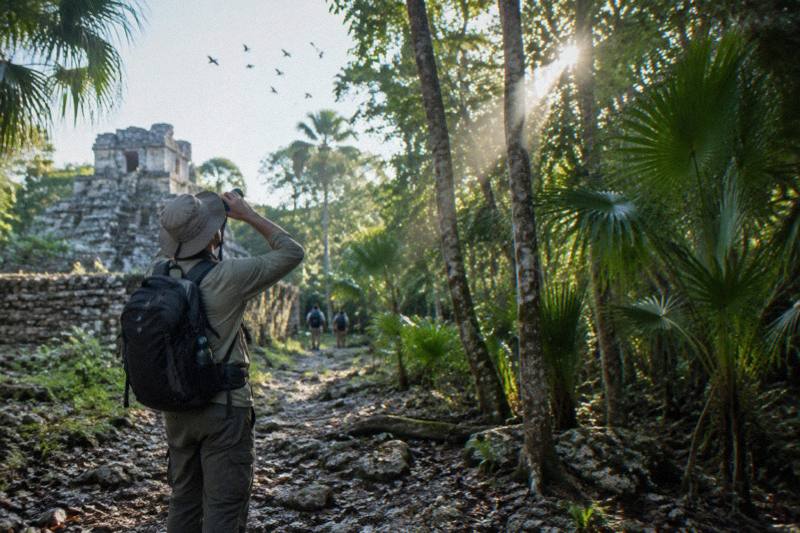
Birdwatching In Sian Ka'an: Species, Seasons And Guides
Sian Ka'an holds one of the largest documented bird inventories of any protected area in Mexico, and almost all of it is reachable on a guided morning out of Tulum or Muyil.
Short answer
Sian Ka'an documents 373 bird species per the 2025 CONANP inventory, with older counts of 330 and more than 300 in between. Guided birding departures from Tulum and Muyil run from $95 to $130 per person for three to five hour trips, and operator guides put the best birding in November to March.
Sian Ka'an was inscribed by UNESCO in 1987 partly on the strength of its birds, and the numbers have only grown since. The current CONANP inventory, cited in the 2025 IUCN Conservation Outlook Assessment, documents 373 bird species inside the reserve's 528,148 hectares, alongside 115 mammals, 72 reptiles and 1,725 invertebrates. For a birder, that inventory is the draw: lagoon systems at Muyil, mangrove channels toward Boca Paila, and coastal flats near Punta Allen stack habitat types inside a single morning's drive from Tulum. This guide lays out what the counts actually say, when to go, which guided birdwatching departures are listed on this site, and what the reserve's own rules mean for your kit.
How Many Bird Species Live In Sian Ka'an?
The answer depends on which inventory you read, and the range is part of the story: UNESCO's listing text gives 330 species with 219 breeding, the Ramsar record for the same wetlands gives 320, and the CONANP 2025 inventory, the most recent official count, documents 373 species. 407 species are recorded across the transition zones, where farmland and secondary forest meet protected habitat.
The older 330 count comes from the original UNESCO nomination, and it still appears on most first-page results. The 373 figure is newer and comes from CONANP's own species inventory, which totals 4,091 documented organisms across the reserve. Neither number is wrong; they are different counting exercises at different times, and so the two figures reflect different survey methods, and no trend in the reserve can be read from them.
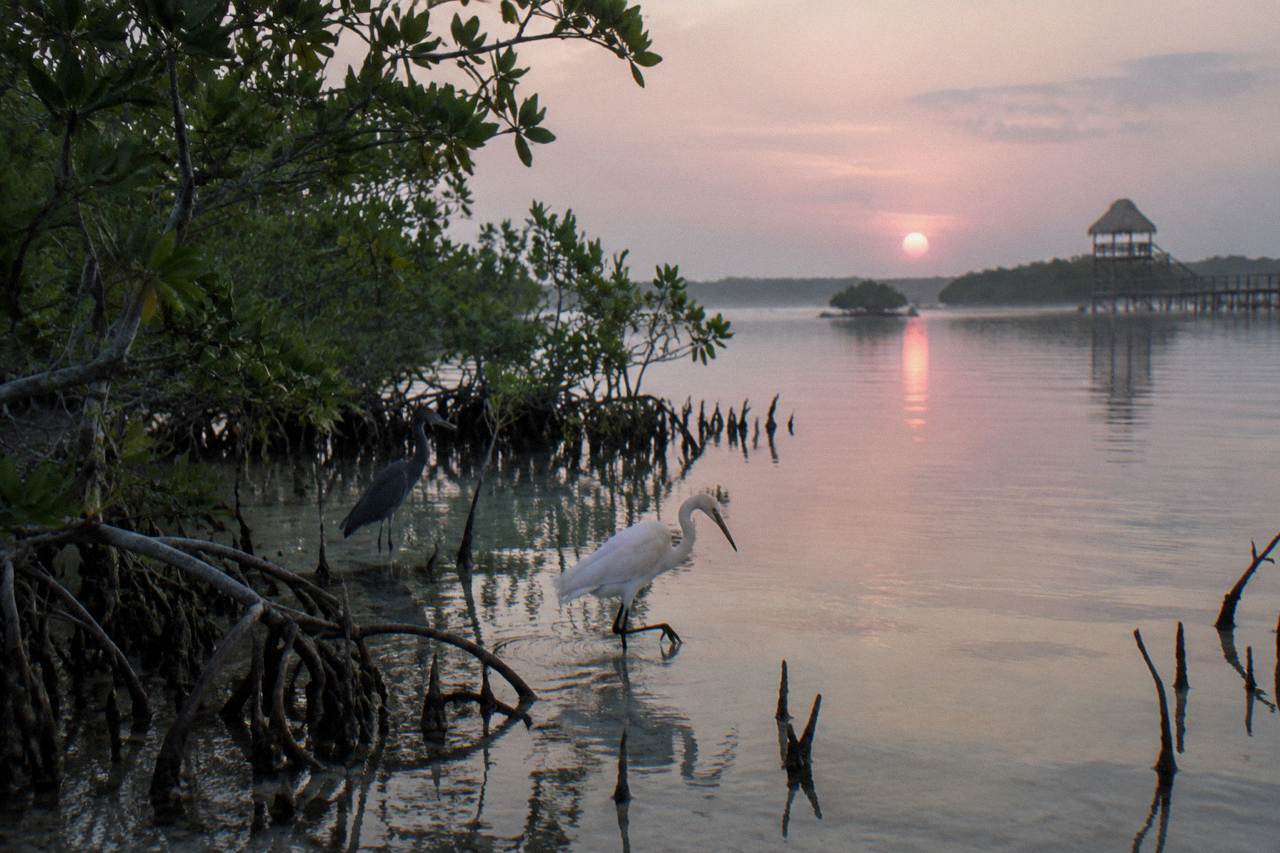
What the counts do not tell you is how the birds are distributed. The practical picture, from the reserve's geography rather than any single survey, is that waders, herons and rails concentrate in the lagoon and canal systems around Muyil and Chunyaxché, while frigatebirds, terns and shorebirds work the coastline toward Punta Allen. One eBird checklist from a 19 July 2026 boat tour in the reserve's Los Lirios area logged two American flamingos, flagged by the observer as extremely rare for that time of year, a reminder that the reserve still produces surprises.
| Source | Species count | Notes |
|---|---|---|
| CONANP 2025 inventory (via IUCN) | 373 birds | Most recent official count; 4,091 total species |
| UNESCO listing text | 330 birds, 219 breeding | Original inscription, 1987, criteria (vii)(x) |
| Ramsar site no. 1329 | 320 birds | Wetland designation, 2003, 652,193 ha |
| Interface zones | 407 birds | Buffer and adjacent lands, CONANP 2025 |
The UNESCO listing and the IUCN assessment are the primary sources behind those rows: the World Heritage listing for Sian Ka'an and the IUCN Conservation Outlook Assessment that carries the 2025 CONANP figures. Context on the reserve's wider fauna, including the manatee and crocodile records that share these lagoons with the birds, is covered in the Sian Ka'an wildlife guide.
When Is The Best Time Of Year For Birdwatching In Sian Ka'an?
No official source publishes migration months for Sian Ka'an, so treat any month-by-month birding calendar with caution. What can be said is that operator guides put the best birding in November to March, when northern migrants are present and resident species are breeding, and that early morning and late afternoon are the optimal hours on any given day. The dry season, November to April, also means fewer mosquitoes and better road access.
The November to March window is a guide view, not a government dataset, and honest birding writing should label it that way. It comes from operator pages and local guides, and it lines up with what a birder would expect from Yucatan geography: winter brings Nearctic migrants into the peninsula's forests and wetlands, and the dry season concentrates waterbirds around permanent lagoons.
Weather shapes the trip as much as the birds. A climate dataset puts Tulum's rainy season from May to October, with 1,120 mm of annual rain falling over 81 rain days, and hurricane season officially runs from 1 June to 30 November per NOAA. The 2026 season had been below normal through early October, with eight named storms and none reaching hurricane strength, but the statistical peak sits in August to October and a serious planner books those months with flexibility. Sargassum, mostly a beach issue from May to October with a June and July peak, barely touches the lagoon birding at Muyil, which happens on inland freshwater.
Season planning overlaps with trip cost planning, and the two questions are worth answering together: the best time to visit Sian Ka'an breaks down the weather windows, while the pricing side is covered in how much a Sian Ka'an trip costs.
For a birder whose dates are fixed by something other than birds, the short version is this: a dry season trip gets you the guide-recommended window and the easiest logistics, but resident species, from ocellated turkey to the herons and spoonbills of the lagoons, are present year round, and CONANP itself describes the reserve as worth visiting all year. A rainy season morning can be excellent precisely because fewer people are on the water.
Which Guided Birdwatching Tours Run In Sian Ka'an?
This site lists five guided birding departures, all from the Tulum or Muyil side, at $95 to $130 per person for trips of three to five hours, plus one private option from $218 per person. Every one lists free cancellation. All five cap groups at six to ten guests. Binoculars are bring-your-own on several lines, and lenders are offered if you ask ahead.
The entry point is the trip run by Eddy, a local specialist whose "Guided Birding with Eddy" meets at 07:00 at the Oxxo in Muyil (no pickup), runs 3 to 4 hours, group max 6, from $95 per person with lunch listed as included, 5.0 from 140 reviews. Of the five birding tours here, it is both the cheapest and the most reviewed. Check availability on the live listing if a small-group morning with a dedicated birder guide is the fit.
The shared-group alternative is the "Shared Group, Muyil Ruins Walk" departure by Amar Aves, 5 hours, group max 10, from $119 per person, 5.0 from 125 reviews, with breakfast, coffee or tea, water and all fees and taxes included. Mexico Kan Tours runs its own 5-hour "Muyil Birding" morning at the same from $119 price, 5.0 from 50 reviews, with the same breakfast inclusions and an optional boat tour and lazy river float at extra cost. The two are different listings from different operators despite the similar shape: compare the pickup terms, since Amar Aves charges a 50 USD per person extra pickup fee from Tulum, while the Mexico Kan line charges the same +50 USD per person from Tulum and quotes pickup north of Tulum on request.
| Tour | Operator | Duration | Group max | From (per person) | Rating |
|---|---|---|---|---|---|
| Guided Birding with Eddy | Birdwatching Tours by Eddy | 3 to 4 hours | 6 | $95 | 5.0 from 140 reviews |
| Shared Group, Muyil Ruins Walk | Amar Aves | 5 hours | 10 | $119 | 5.0 from 125 reviews |
| Muyil Birding, Optional Boat Add-On | Mexico Kan Tours | 5 hours | 10 | $119 | 5.0 from 50 reviews |
| Jungle Walk, Mayan Village Route | Mexico Kan Tours | 5 hours | 6 | $119 | 4.5 from 12 reviews |
| 3-Hour Small Group, Max Eight | Yucatan Outdoors | 3 hours | 8 | $130 | 5.0 from 9 reviews |
Two details in that table deserve attention. The Yucatan Outdoors line is the only one that names the reserve entrance fee explicitly, and it also includes loaner binoculars with a bird guide book in its listed inclusions, which narrows the real price gap with the cheaper lines. And the 4.5 rating on the Jungle Walk, Mayan Village Route tour reflects a pool of just 12 reviews, not a quality problem; with fewer tours to compare, the review count matters as much as the rating itself.
The private option deserves its own paragraph. Mexico Kan Tours' private birdwatching tour in Muyil runs 6 hours with pickup, breakfast, coffee or tea, bottled water and all fees and taxes included, from $218 per person, 5.0 from 13 reviews, with an optional lazy river float and boat tour at +75 USD per person. On a private line the listing prices every traveler, so a couple should read that as a per person figure, not a group total. Private birding buys you pace control: the ability to sit on a mixed flock or work a stakeout for an endemic rather than move with a group.
Where Should You Go Birding Around Muyil And The Lagoons?
Muyil is the practical center of birding in the reserve: the archaeological zone sits 23 km from Tulum on Federal Highway 307, its INAH entry is MXN 80 for nationals and foreign residents and MXN 145 for foreign visitors, and the trails and lagoon dock beyond it reach the freshwater habitats where herons, spoonbills and raptors concentrate. The site reopened to the public about 11 February 2026 after closure since June 2024.
The reopening matters for planning. Muyil closed in June 2024 for conservation work across 11 structures and reopened in February 2026 with a new visitor unit, parking, restrooms and signage. Hours are daily 8:00 to 17:00 with last entry at 16:30, and INAH's site rules are strict: no food, no pets, no smoking. Drones are separately prohibited, both by CONANP across protected natural areas and by INAH over archaeological zones, so leave the quadcopter behind; there is no birding-photography exception. The full index of guides sits on Sian Ka'an Reserve.
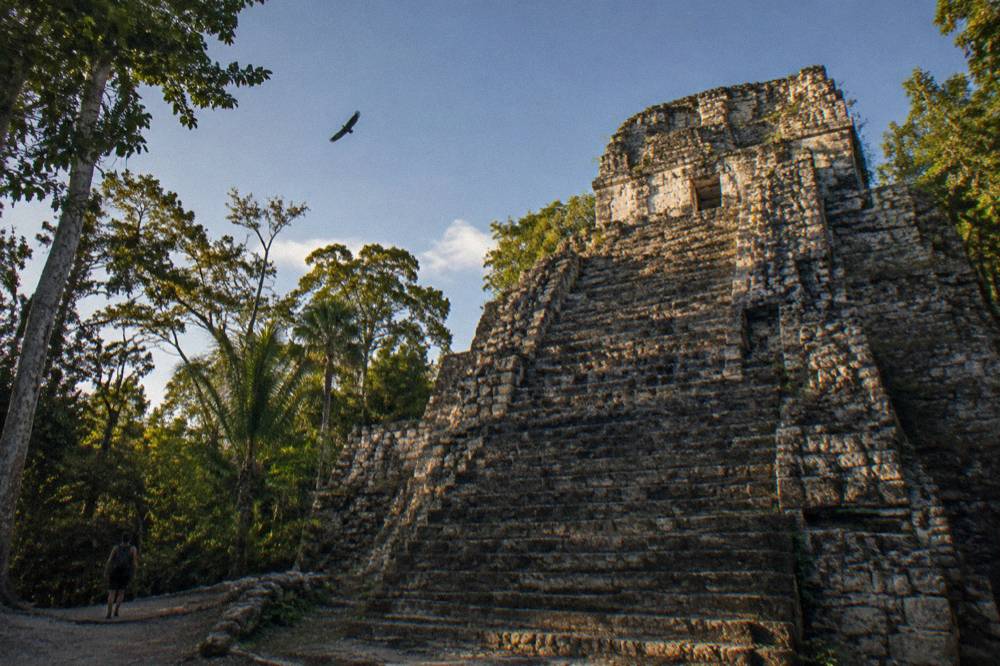
From the ruins, the Camino Blanco trail and boardwalk run toward the lagoon dock and an observation tower, and this is the corridor most guided birding walks use. Boat operations on Muyil lagoon and the ancient canals are run by the local Mayan ejido cooperative from a palapa near the site, and the canal float itself, roughly 950 m through a hand-dug ancient canal, is described by operators as a 30 to 45 minute drift with life jackets provided and required. Birders will care about the float less as a swim and more as a slow, silent transect through mangrove edge, which is exactly where the shy species sit.
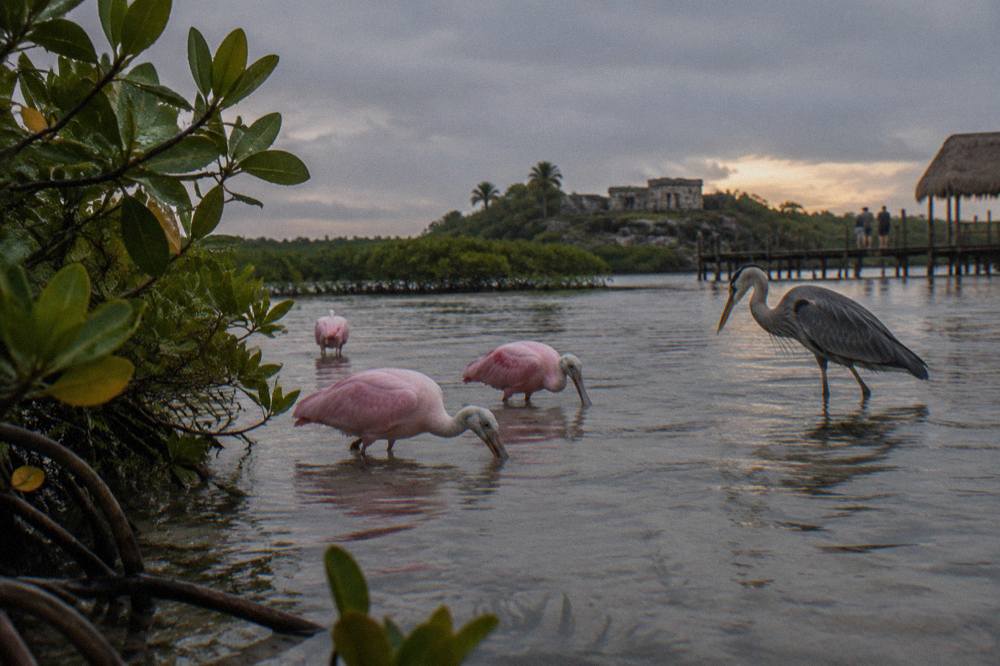
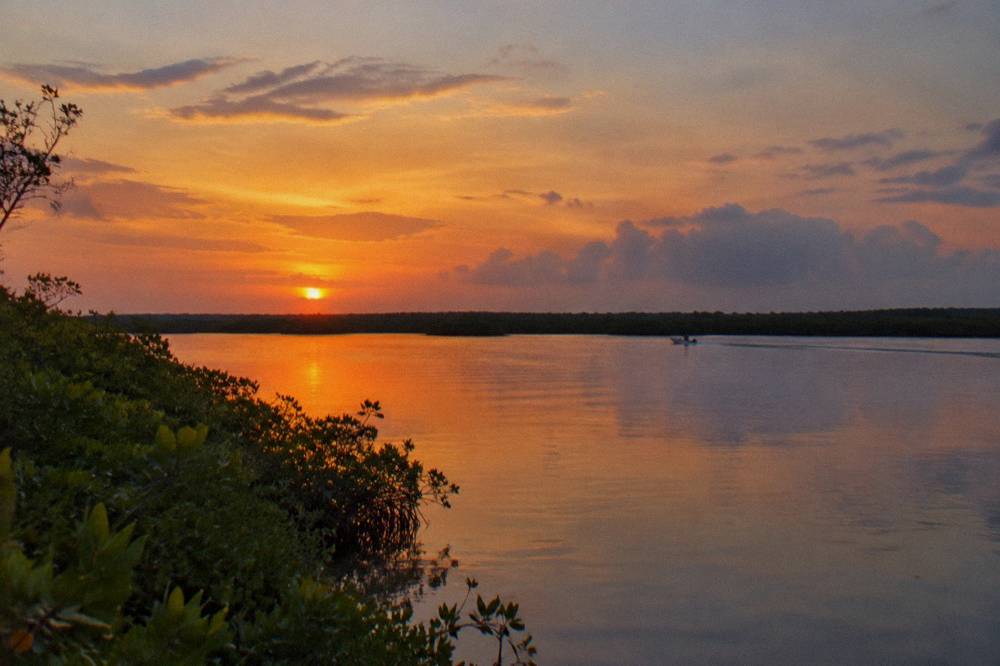
The other birding geography is the coast. Boat trips out of Punta Allen and the Boca Paila area pass mangrove roosts where roseate spoonbills and frigatebirds settle in the late afternoon, and sunset departures are built around that return-to-roost movement. That is a different product from the Muyil walks, and it is covered from the water side in the Punta Allen full day trip guide. If your interest is specifically dawn on flat water, the Sian Ka'an kayaking guide covers the sunset and sunrise paddle departures that double as low-impact birding platforms.
One logistical note that birders ignore at their peril: the road from the Arco Maya checkpoint to Punta Allen is about 46 to 50 km of dirt, currently a 3 to 4 hour drive, with rehabilitation about 80 percent complete as of 9 October 2026 and a projected 40 to 45 minute drive once finished. Most rental agencies prohibit the road. Birding the coastal side means taking a tour or an authorized operator, which is one reason the guided departures dominate this corner of the reserve. The Boca Paila road guide covers the current road state in detail.
Do You Need Binoculars And A Guide Inside The Biosphere?
Access to the reserve runs through authorized points such as Muyil and the Punta Allen road, with the CONANP entry fee of MXN 225 per person per day collected at the casetas and a paper bracelet as proof, and several birding listings state plainly to bring your own binoculars, offering lenders only if you ask in advance. A certified local guide is standard on reserve tours, and the reserve's rules prohibit feeding, touching or chasing wildlife.
The binocular question is the one that catches visitors out. Three of the five birding tours on this site exclude binoculars but offer to lend a pair: bring your own, and tell the operator if you cannot. The Yucatan Outdoors 3-hour small group line is the exception, including loaner binoculars and a bird guide book alongside the entrance fee in its listed inclusions, from $130 per person, 5.0 from 9 reviews. If you own good glass, pack it; if you do not, pick your tour accordingly or say so when booking.
The fee side has a wrinkle worth a table, because the listings handle the two entry fees differently and the difference is real money on a family trip.
| Tour line | Reserve fee MXN 225 | Muyil INAH fee | Binoculars |
|---|---|---|---|
| Guided Birding with Eddy | Not stated in listing | Not stated | Not stated |
| Amar Aves shared group | Listed as included, but lagoon admission marked not included | Confirm with operator | Bring your own, lenders offered |
| Mexico Kan Muyil birding | Fees listed as included; reserve stop shows admission not included, confirm | Check listing | Bring your own, lenders offered |
| Yucatan Outdoors 3-hour | Included (listed) | Not stated | Included, with bird book |
| Private Muyil birding | Included (all fees and taxes) | Included (all fees and taxes) | Bring your own, lenders offered |
"Not stated" is not the same as "not included"; it means the listing does not say, and the operator's live listing is the place to confirm before you assume. The official fee structure, including the under 12, senior, disability and student exemptions, is on the CONANP page for the reserve, and the full fee picture is unpacked in the entrance fee explainer.
The guide question answers itself once you read the access rules: independent visits are restricted, cooperatives and licensed operators manage entry at the authorized points, and certified guides are the norm on reserve tours. Beyond the rules, a local ear is the difference between walking a trail and working it. The best birding in tropical forest is auditory, and a guide who knows the calls will find far more birds. For the wider kit question, including the reserve's reported no-sunscreen rule and the clothing-first approach that follows from it, see what to bring on a Sian Ka'an tour.
What Can A First Birding Morning In Sian Ka'an Actually Look Like?
Expect a 6 or 7 a.m. start at the Muyil meeting point, with Tulum pickup extra on most tours, and two to three hours on forest trails and the boardwalk toward the lagoon, with breakfast somewhere in the middle and a wrap by late morning, all inside a group of six to ten. The morning list leans toward herons, egrets, parrots, toucans, raptors and woodpeckers, plus pelicans and frigatebirds over the lagoon, and spoonbills returning to mangrove roosts if you add the boat.
The shape of that morning comes straight from the tours on this site. The Mexico Kan Muyil birding line and the Amar Aves shared group both run 5 hours with breakfast, coffee or tea and water included, which tells you the departure is at dawn and the meal is on the trail. Eddy's 3 to 4 hour line is shorter and tighter, group max 6, from $95 per person, and includes lunch rather than breakfast, suggesting a slightly later frame. The private line stretches to 6 hours with the option to bolt on the boat and float.
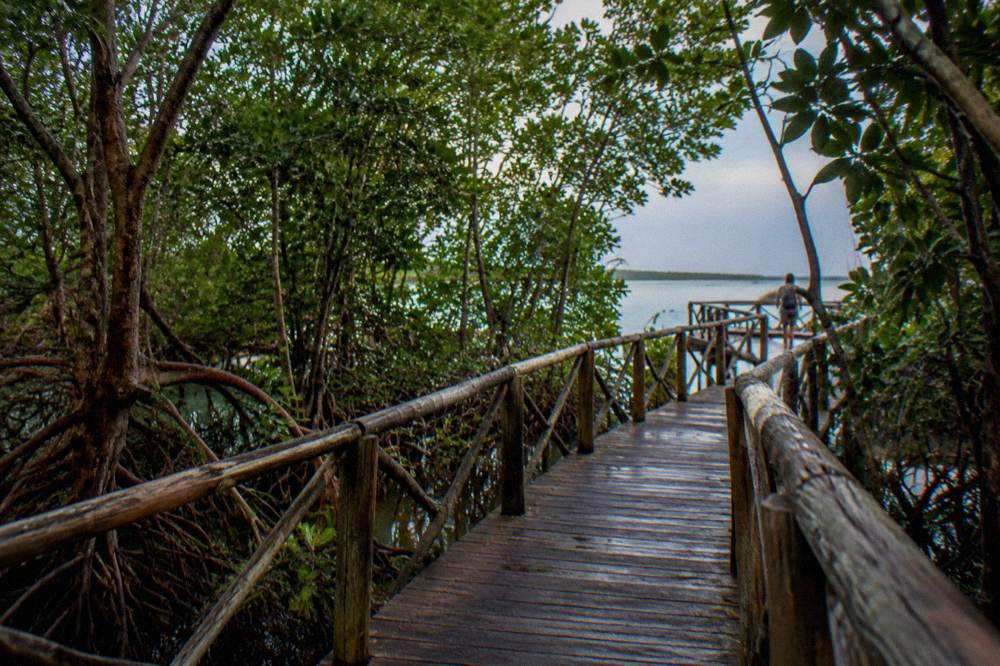
What you should not expect is any promised headline species. The reserve's representative fauna lists, from CONANP's own ficha, name the ocellated turkey among endemic species, and the manatee and both crocodile species among its representative animals, but no official source publishes sighting rates or months for any of them. A listing or guide may describe dolphins, turtles or a particular bird as commonly reported, and that is the honest ceiling of the claim. Birders know this instinctively; it is worth saying anyway, because the reserve's marketing sometimes does not.
For birders who want the water without a boat commitment, the cooperative kayak line from Community Tours Sian Ka'an, 4.5 hours with Mayan breakfast and lunch, from $102 per person, is a strong companion product, and the sunset kayak by Yucatan Outdoors, 3 hours, group max 8, from $120 per person, 5.0 from 316 reviews, an evening paddle timed for the last light of day.
If the morning goes well, the natural extension is the boat: the lagoon and canal float out of Muyil is sold as an add-on at extra cost on the Mexico Kan birding lines and bundled into several of the full canal tours compared in the Muyil floating canals guide. Birding from the water changes your angle on the mangrove edge, and the drift is quiet enough not to flush what you are watching.
How Does Birdwatching Here Compare With Other Reserve Activities?
Birding is the cheapest guided way into the reserve, from $95 per person against from $102 for the cooperative kayak and from $162 for the cheapest canal float package, and it is the only activity family on this page with a from-price under $100. The tradeoff is distance from the coast: the birding lines stay on the Muyil side, so travelers set on dolphins and reef snorkel need a boat day trip instead, and the two can be combined across two mornings.
The comparison is worth a table, because the price floor across these tours tells a clean story.
| Activity family | Cheapest listing | From (per person) | Duration |
|---|---|---|---|
| Birdwatching | Guided Birding with Eddy | $95 | 3 to 4 hours |
| Kayaking | Cooperative kayak tour | $102 | 4.5 hours |
| Muyil canal floats | Ancient Maya canals tour | $162 | 8 hours |
| Boat day trips | Dolphins and turtles day trip | $179 | 10 hours |
| Private tours | Private birdwatching, Muyil | $218 | 6 hours |
That ladder is why birding is such a good first morning: it is the lowest-cost, lowest-commitment guided entry, it starts early enough to leave the afternoon free, and it builds local knowledge that makes a second day, on the water or at the ruins, better. Travelers deciding between the ruins walk and the water can also compare Muyil against the Tulum ruins or weigh cenotes against Sian Ka'an if the group is split.
One planning note on where to base: every birding tour covered here departs from the Tulum or Muyil side, and several charge extra for pickup. The Amar Aves trip lists a 50 USD per person pickup fee from Tulum. The Sian Ka'an Muyil Birdwatching with Guide outing from Riviera Maya, meanwhile, sets its meeting point in Muyil itself. Staying in Tulum keeps every option open, and the where to stay guide covers the tradeoffs. This site, Sian Ka'an Reserve, keeps all 26 tours and the comparison tools in one place, including the homepage comparison for choosing between activity families.

Common Questions About Birdwatching In Sian Ka'an
How Many Bird Species Are In Sian Ka'an?
The CONANP 2025 inventory documents 373 species, the Ramsar record lists 320, and the original UNESCO listing text gives 330 with 219 breeding. A further 407 species are counted in the reserve's interface zones.
When Is The Best Month For Birdwatching In Sian Ka'an?
No official source publishes migration months. Operator guides put the best birding in November to March, a guide view rather than a government dataset, and early morning is the best time on any day. The dry season, November to April, also means easier logistics.
Do I Need Binoculars For A Birding Tour In Sian Ka'an?
Yes, bring your own on most lines. Three birding listings state binoculars as bring-your-own with lenders offered if you ask ahead; the Yucatan Outdoors 3-hour small group tour is the one that includes loaner binoculars and a bird guide book.
How Much Does A Birdwatching Tour In Sian Ka'an Cost?
Shared guided birding runs from $95 per person for Eddy's 3 to 4 hour trip to $130 for the Yucatan Outdoors small group line. The private 6-hour Muyil birding tour runs from $218 per person, with the listing pricing every traveler.
Can You Go Birdwatching In Sian Ka'an Without A Tour?
Access is limited to authorized points such as Muyil and the Punta Allen road, cooperatives and licensed operators manage entry, and certified guides are standard on reserve tours. Independent visits are restricted, so a guided departure is the practical route for birders.
Are Flamingos Seen In Sian Ka'an?
Not reliably. One eBird checklist from 19 July 2026 recorded two American flamingos on a boat tour in the reserve and flagged them as extremely rare for that time of year. No official source promises flamingos, and roseate spoonbills are the regular pink wader here.