Tulum Ruins Or Muyil: Which Maya Site Is Worth Your Day?
Two Maya sites sit a short drive apart on the Riviera Maya, and most visitors have time for one. Here is how the cliffside Tulum ruins and the quiet, jungle-covered Muyil zone actually compare, from crowds and setting to the canal float that only one of them offers.
Short answer
Muyil charges MXN 80 for nationals and foreign residents and MXN 145 for foreign visitors, open 8:00 to 17:00 with last entry 16:30. Tulum's entry fee and opening hours can change, so check the official INAH listing for current figures before you go. The comparison itself is simple: Tulum is the coastal icon, Muyil the quiet jungle site that pairs with the Sian Ka'an canal float.
Why Compare Tulum And Muyil For Maya Ruins Near Sian Ka'an?
Most Riviera Maya visitors have one ruins day, and the choice comes down to setting over substance: Tulum is the postcard site on a cliff above the Caribbean, while Muyil is a quiet, jungle-covered zone 23 km southwest of Tulum that opens onto the ancient Maya canals inside the Sian Ka'an Biosphere Reserve. The better pick depends on whether you want a famous view or a half day of combined history and water. Whichever site wins your day, the cheapest ways into Sian Ka'an and free stops near Muyil explains how to pair the ruins with the reserve's canals without paying tour prices.
The comparison matters more now than it did two years ago. Muyil closed in June 2024 and reopened to the public around 11 February 2026 after a conservation program that covered 11 structures and added a new visitor unit with parking, restrooms, signage and trails, so much of what older blog posts describe has changed. The Tulum ruins, by contrast, have been continuously visited and need no reintroduction: a walled Maya trading city perched on a cliff above the Caribbean shore.
What the older posts do not tell you is that Muyil is not really competing as a ruins-only destination. Its listing in the INAH catalog places it at Federal Highway 307 km 208, and from the site a boardwalk trail and boat dock run out to Muyil Lagoon, where the local Maya cooperative runs boat trips and the famous float down a hand-dug ancient canal. That makes Muyil the gateway to a whole Sian Ka'an day, not just a second archaeological stop. The Sian Ka'an Reserve site covers the rest of that world: the lagoons, the canals, the birdwatching mornings and the Punta Allen boat trips.
If your heart is set on the sea view, go to Tulum. If you want the site where the ruins are one third of a bigger itinerary, Muyil wins on arithmetic alone, and the rest of this guide lays out exactly where each site is stronger.
How Do The Settings Of Tulum And Muyil Actually Differ?
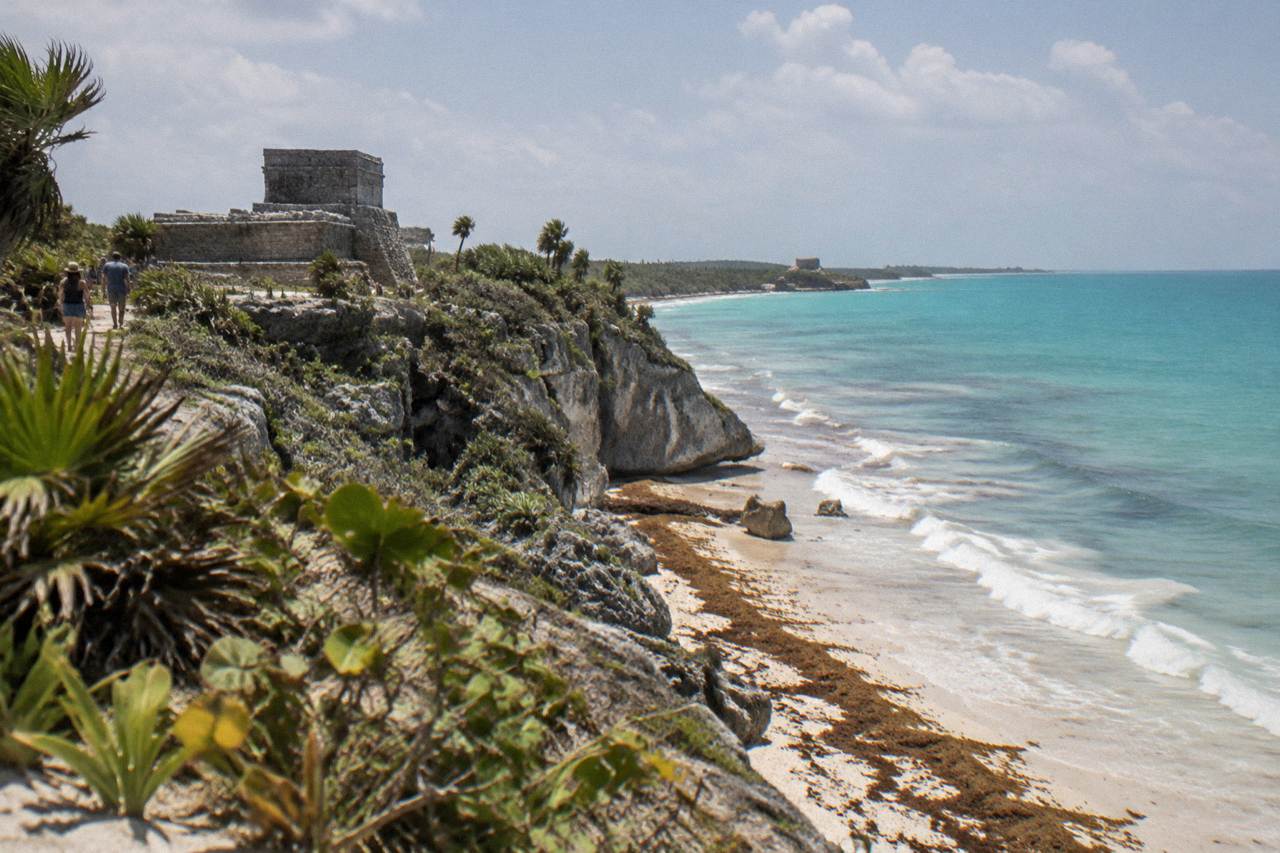
Tulum is a compact walled city on a low cliff above a white-sand beach, with the sea as the constant backdrop, while Muyil is an inland site wrapped in tropical forest, topped by a tall pyramid on the Yucatan coast, and connected by trail and canal to lagoons inside the biosphere reserve. One frames the Maya world against the Caribbean, the other against the jungle and freshwater the trade routes used.
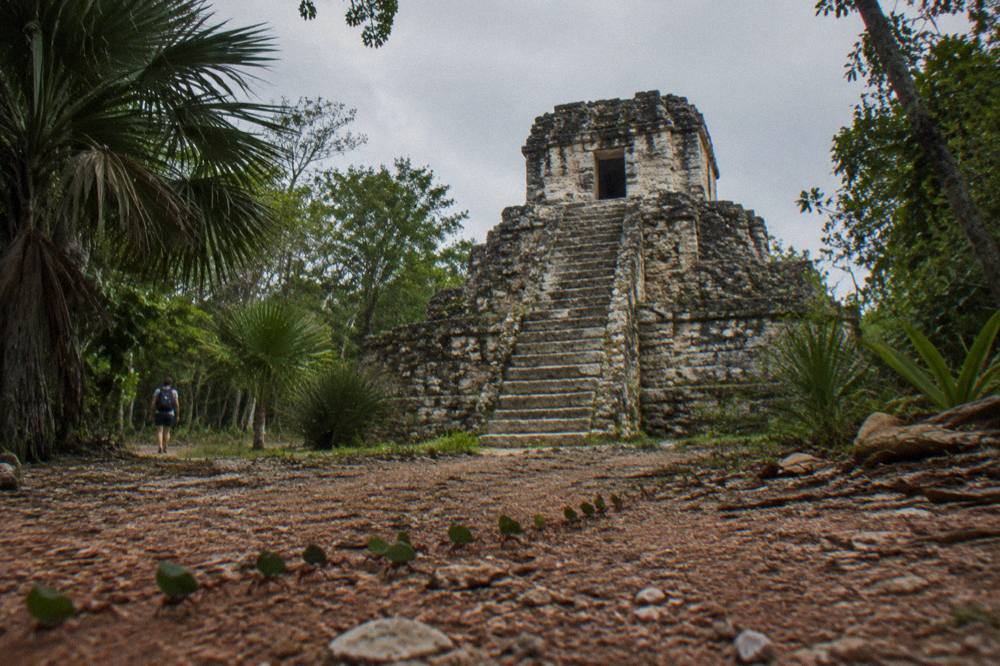
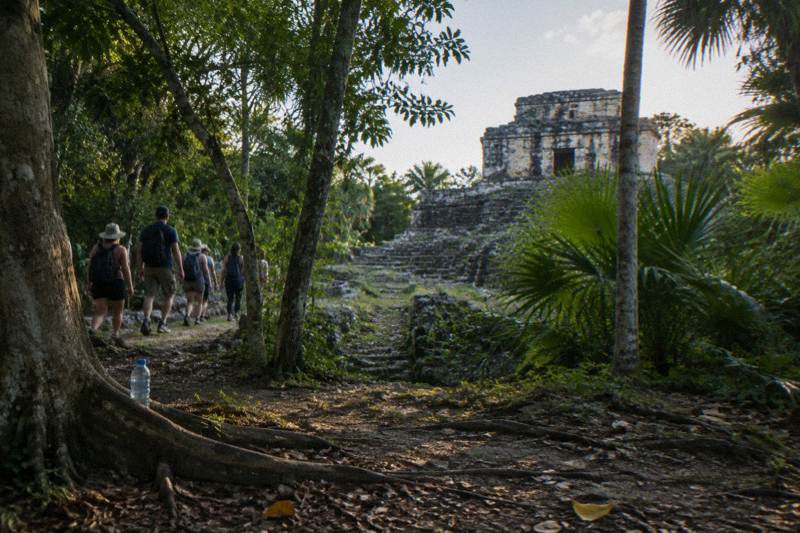
The settings produce different atmospheres, and it is worth being honest about both. Tulum's setting is dramatic and public: you walk a network of paths between restored walls, temples and lookout points, with the turquoise water below and usually a crowd sharing the view. The beach at the foot of the cliff is one of the most photographed stretches of coast in Mexico. Muyil, by contrast, is quiet by design. The site is reached through the new visitor facilities added during the 2026 reopening, and beyond the entrance plaza the paths run under canopy, past structures still partly wrapped in vegetation, toward the lagoon boardwalk. On a weekday morning you can have long stretches of it nearly to yourself.
The other difference is what the setting was for. Tulum was a late, fortified trading port, and its position on the cliff speaks for itself: watch the sea, tax the canoe traffic. Muyil sits beside the lagoon at Chunyaxché, where float tours drift along the ancient Maya canals through the reserve, which is exactly why the floatable canal still exists next to it. UNESCO's listing for the reserve notes more than 300 bird species in the wider property, a count CONANP's 2025 inventory refines to 373 recorded species, so the jungle setting is not scenery alone, it is a functioning ecosystem.
For planning purposes, the practical takeaway is simple. Tulum delivers a concentrated wow in a small, walkable footprint with the beach as the finale. Muyil delivers a slower build, ruins first, then forest trail, then lagoon, then canal, and it rewards the traveler who treats it as a sequence rather than a stop.
How Crowded Are Tulum And Muyil Compared?
Tulum is the busier, better-known site and it shows, with tour groups arriving from Cancun from mid-morning onward, while Muyil receives a fraction of that traffic and, since its February 2026 reopening, spreads visitors across a larger site with new trails and facilities. Arriving early matters at both, but at Tulum it is the difference between a visit and a shuffle.
Attendance figures for the two sites are not published, so this comparison stays qualitative, but the qualitative gap is not subtle. Tulum's parking lots fill, the cliff-edge viewpoints queue, and the midday heat plus the crowds push most visitors through in a single loop. Muyil's fresh reopening means it is still rebuilding its audience: the 2026 coverage of the reopening describes new visitor services and cooperative boat operations, not busloads.
The crowd question ties directly to the time question. A crowded site eats time: you wait to park, wait at the entrance, wait at each viewpoint. A quiet site gives it back, because you linger where you want. That is the real argument for pairing Muyil with the canal float, the sequence runs at your pace, and the only queue is the cooperative's boat dock on the lagoon.
There is a middle path for people who want both atmospheres, and it is the one many Tulum-based travelers land on: do Tulum at opening time as a self-guided morning, then move to Muyil for the ruins-plus-float afternoon. The sites are close enough that this works without rushing, and the deeper guide to the Muyil ruins themselves covers what there is to see, structure by structure. If instead you would rather skip the logistics entirely, the combo tour from Tulum that includes Muyil, the boat ride and the canal float handles the whole sequence with pickup included.
How Much Time Do You Need At Each Maya Site?
Tulum is typically a one-and-a-half to two-and-a-half hour visit for the archaeological zone itself, while Muyil's ruins alone take a little less time, but the full Muyil experience with the forest trail, the lagoon boat ride and the canal float runs closer to four to five hours on site, which is why the guided Muyil days from Tulum are six hours door to door. If you're wondering whether that bigger time commitment actually pays off, the full verdict on whether Muyil is worth visiting covers the fees, current hours, and who the site really suits.
The asymmetry surprises people. On paper two ruins are two ruins. In practice Tulum is a contained loop: entrance, main castle, the temple of the wind, the cliff viewpoint, optionally the beach below, done. You can extend it with the adjacent parking-lot commerce and the beach clubs, but the site itself does not demand more of your day.
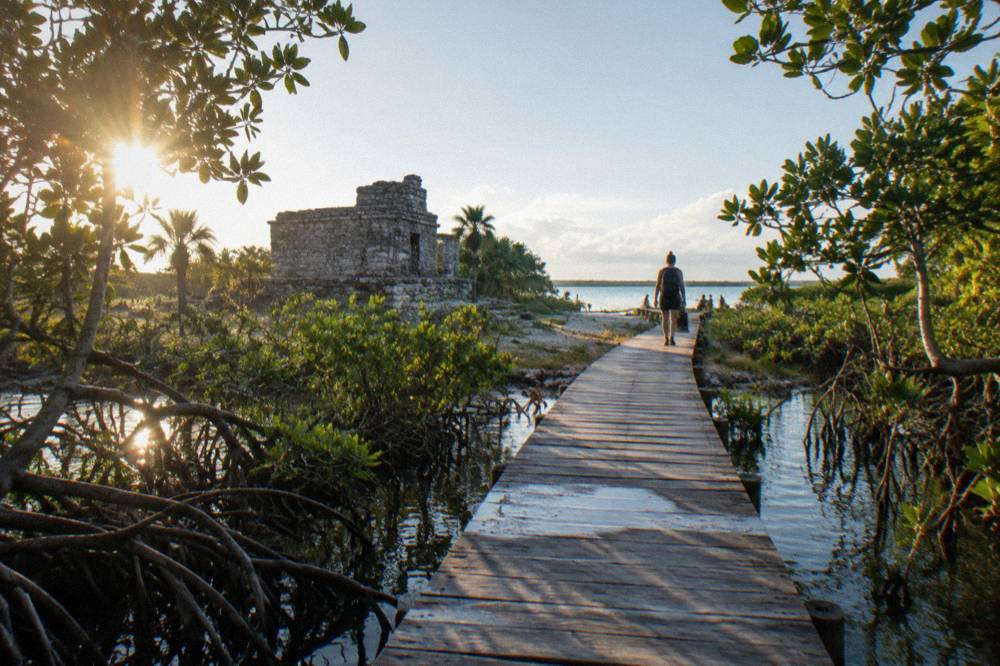
Muyil starts at the INAH zone and keeps going. The fresh reporting on the reopened site describes the Camino Blanco trail from the ruins to the lagoon dock and observation point, and the canal float itself lasts roughly 30 to 45 minutes through nearly a kilometer of ancient canal, with life jackets provided by the cooperative. Add the boat crossing of the lagoon and you have a genuine half-day outing before you count the drive from Tulum. The guided tours reflect that: the Muyil Archaeological Site and Sian Ka'an guided day from Tulum runs 6 hours for a maximum of 12 guests, from $219 per person, with hotel pickup and drop-off in Tulum, bottled water and snacks included, 4.9 across 846 reviews. The shorter float-only option, the Sian Ka'an Muyil floating canals listing, runs 3 to 5 hours from $170 per person and skips the meal. Before you book anything, our guide to swim spots, snorkel stops, and vest rules in Sian Ka'an tells you exactly where you can get in the water and which tours build in the most swim time.
| Itinerary | What it covers | Typical time on site |
|---|---|---|
| Tulum ruins only | Walled city loop and cliff viewpoints | About 1.5 to 2.5 hours |
| Muyil ruins only | INAH zone and structures | About 1 to 1.5 hours |
| Muyil ruins and float | Ruins, forest trail, lagoon boat, canal float | About 4 to 5 hours |
| Full guided Muyil day from Tulum | Everything above plus transport and guide | 6 hours door to door |
Budget the day, not the site. If you are staying in Tulum and want one ruins stop plus an afternoon by the pool, Tulum fits. If you want a day with history, forest, lagoon and water in one arc, Muyil is the site that contains all of it, and the listing for the Muyil ruins and lazy river tour family breaks down what each version includes.
What Does Muyil Cost Compared With Tulum Ruins?
Muyil's entry is simple: MXN 80 per person for nationals and foreign residents, MXN 145 for foreign visitors, with the zone open daily 8:00 to 17:00 and last entry at 16:30. The Tulum ruins entry fee and opening hours are not published here, since they can change; check the official INAH listing before you go.
The Muyil side of the ledger is firm. INAH categorizes the zone as a Category III site, and the fee is paid at the entrance to the archaeological zone. Two further costs can apply on a full Muyil day: the Sian Ka'an Biosphere Reserve federal entry fee of MXN 225 per person per day, collected by CONANP at the authorized checkpoints including Caseta Muyil, and, per the 2026 reopening coverage, an additional trail fee reported at MXN 50 for the path to the lagoon dock and observation deck. Whether the reserve fee applies to you depends on the tour: some listings include all fees and taxes, others state the MXN 225 as a separate payment. The community-run canals tour, for example, lists the federal fee explicitly as an exclusion, approx. MXN 225 per person, payable on site. The wider set of guides lives on Sian Ka'an Reserve.

| Cost item | Amount | Who charges it |
|---|---|---|
| Muyil ruins entry, nationals and foreign residents | MXN 80 | INAH |
| Muyil ruins entry, foreign visitors | MXN 145 | INAH |
| Muyil lagoon trail and deck | Reported MXN 50 | Site operator |
| Sian Ka'an reserve entry | MXN 225 per person per day | CONANP |
| Tulum ruins entry | Varies: confirm with INAH | Check INAH |
The honest budgeting point is that neither site is expensive by international standards, and the guided tours wrap most of the line items into one price. The ruins-plus-float combo from Tulum at from $219 per person covers entry fees, guide, transport, snack and soft drinks, which removes the guesswork entirely. The floating canals tour from Tulum Diving and Travel at from $170 per person likewise lists all taxes, fees and handling charges plus national park fees among its inclusions. Whichever route you take, carry cash in pesos for the INAH window and any on-site fee that your tour does not prepay.
For the full picture of what a reserve day costs across every tour family, the companion answer on the entrance fee for the biosphere works through each listing line by line.
How Does The Muyil Canal Float Change The Comparison?
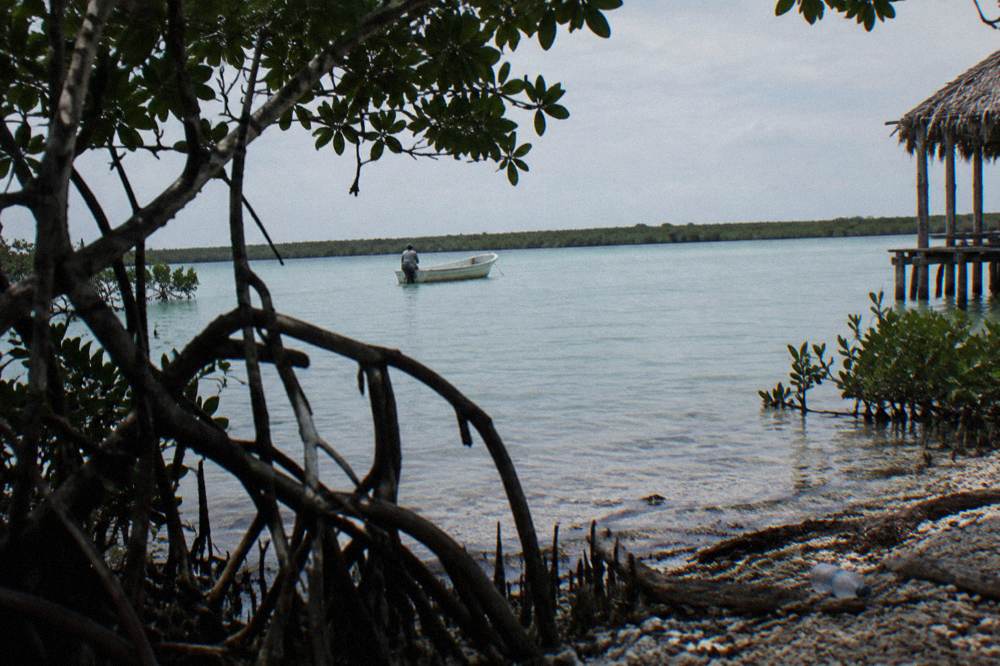
The canal float is the single biggest differentiator: from the Muyil lagoon dock you drift nearly a kilometer down an ancient Maya hand-dug canal through mangroves, carried mostly by the gentle current, an experience the Tulum site simply cannot offer because its world faces the open sea rather than the lagoon system behind it. If the float is on your list, the ruins comparison is already decided.
The mechanics are well documented. The 2026 coverage of the reopened site describes the cooperative-run dock on Muyil Lagoon, a boat crossing to the canal mouth, and a contemplative float of roughly 30 to 45 minutes through the canal, with the distinctive life jackets the cooperative hands out. The float ends where the boat picks you up again. Travelers who book it as part of a guided day get the same sequence with a certified guide narrating the archaeology and ecology around it.
Three guided versions of the float appear among the tours on this site, and they suit different travelers. The flagship Muyil Archaeological Site and Sian Ka'an guided tour from Tulum, operated by Mexico Kan Tours, is the ruins-first version: 6 hours, group max 12, from $219 per person, hotel pickup in Tulum included, free cancellation listed. The lazy river version from the same operator, from $219 per person, rated 4.8 across 439 reviews, adds a taco meal and runs the same 6-hour frame. The ruins walk plus float, no meal, from Tulum Diving and Travel, from $170 per person, 4.7 from 49 reviews, is the short hit at 3 to 5 hours with no meal stated. The float-only option suits a traveler already staying near Tulum with a free afternoon; the full combos suit anyone who wants the ruins explained rather than just walked past.
One planning note that belongs here and nowhere else: the float, like any outdoor activity, can shift with the weather, and the reserve's rules apply on the water. The CONANP visitor rules, as reported, list sunscreen among the prohibitions inside the reserve, and "reef-safe" has no legal meaning in Mexico, so the standard advice is a rash guard and a hat rather than a bottle. Shade and clothing, not lotion, is the rule of the day.
Which Maya Site Suits A Birdwatching Morning Better?
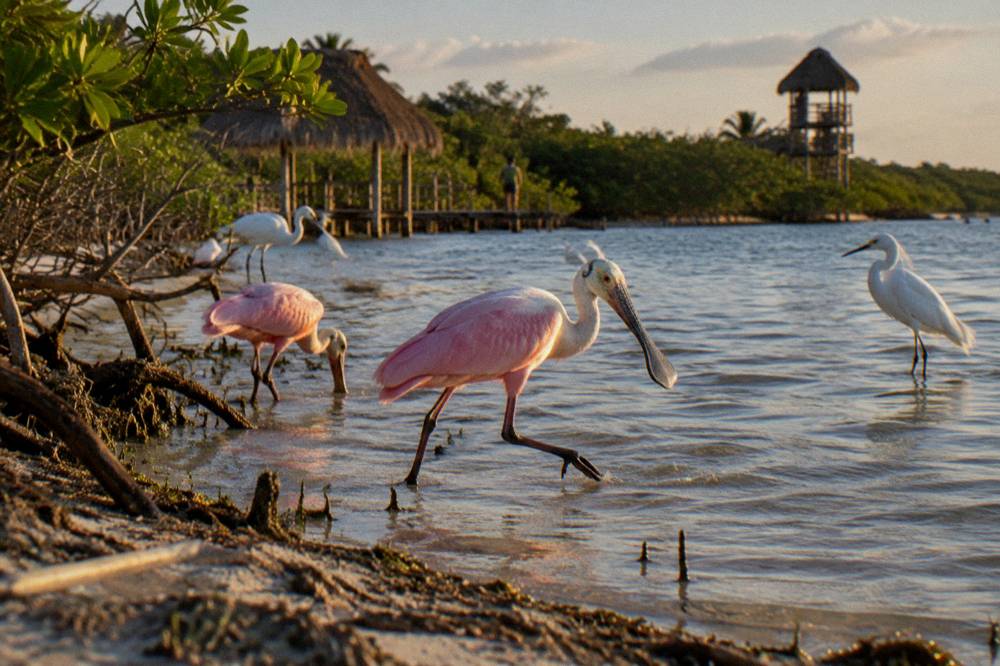
Muyil is the clear pick for birds: the site sits at the edge of the lagoon and wetland system where CONANP's 2025 inventory records 373 bird species in the reserve, and guided birding walks leave from the Muyil entrance at first light, while the Tulum ruins zone is a compact urban-edge site where birding is incidental rather than the point.
The numbers behind that are official. The IUCN Conservation Outlook assessment citing CONANP 2025 data puts the reserve's documented birds at 373 species, with 407 noted in interface zones, and the UNESCO listing carries an older count of 330 species of which 219 breed. Tulum's coastal strip has its own birds, frigatebirds overhead chief among them, but nobody books a Tulum morning for a species list.
At Muyil, people do. The shared-group birdwatching tour meets at Muyil at 06:00, runs 5 hours; Tulum pickup adds $50, from $119 per person, and includes all fees and taxes, bottled water, breakfast, coffee or tea; the listing asks you to bring your own binoculars, with loaners available if you ask ahead. It holds a 5.0 rating from 125 reviews. Operator guides put the best birding in the dry season, November to March, when the dry season, November to March, brings the best birding. Early mornings and late afternoons are the most productive windows for bird activity in the reserve.
There is also a private birding version at Muyil, 6 hours from $218 per person with breakfast, coffee, air-conditioned vehicle and all fees included, from Mexico Kan Tours, if your group wants the guide's full attention and the option to add the boat tour and lazy river float at a listed extra of $75 per person. The dedicated Sian Ka'an birdwatching guide compares every birdwatching tour on this site. The short version: birds push the decision to Muyil, and the shared tour is the value pick.
Can You Visit Tulum And Muyil In The Same Day?
Yes, and it is a common pairing: the sites are about 23 km apart by road, with Caseta Muyil recorded 23 km southwest of Tulum on Federal Highway 307, so an early Tulum start at opening time followed by a midday move to Muyil works comfortably, and a guided Muyil afternoon absorbs the rest. The one thing to avoid is doing both in the midday heat in the wrong order.
The order matters more than the distance. Tulum is hottest and most crowded from late morning, so the standard smart plan is Tulum at 8:00 or 9:00, out by mid-morning, lunch in Tulum town, then Muyil for the cooler afternoon hours, which also lines up with the float, since drifting down a canal in the early afternoon shade is a far better proposition than queuing at a cliff viewpoint at noon. Muyil's last entry is 16:30, so the afternoon slot has a hard edge: arrive by mid-afternoon or the INAH window closes on you.
Transport is the second decision. Both sites sit directly on Highway 307, which makes taxis, colectivos and rental cars all workable for the Tulum-to-Muyil leg, though colectivo schedules are not published, so confirm locally. If you would rather not move yourself, the guided options solve it: the combo tour from Tulum picks up at hotels in Tulum and handles the whole Muyil sequence, with extra transport fees listed only for pickups north of Tulum, rising in steps from $10 to $45 per person depending on how far up the coast you are staying. That fee ladder is printed on the listing and worth reading before you book from Playa del Carmen or Cancun.
A word on extending the day. Some travelers try to bolt Punta Allen onto a two-ruins day, and the arithmetic fights them: the Punta Allen road from the Caseta Arco Maya checkpoint is about 46 to 50 km of dirt, currently a 3 to 4 hour drive each way while rehabilitation work continues, with about 80 percent of the work reported complete in October 2026. That is its own full day, covered in the Punta Allen road guide, not a bolt-on.
Which Site Should You Choose For Your Ruins Day?
Choose Tulum if the sea cliff, the postcard and the beach below are the point, and choose Muyil if you want ruins plus forest, lagoon, canal float and birds in a single quiet arc, because Muyil is the only one of the two that converts a ruins stop into a full Sian Ka'an day. Travelers who can spare two mornings do both, in that order.
The decision usually collapses onto one honest question: is this a ruins day or a reserve day? If it is a ruins day, Tulum delivers the most famous Maya silhouette in Mexico, and nothing here argues against it, only against doing it at noon. If it is a reserve day, Muyil is not even really competing with Tulum; it is competing with itself as a gateway, and it wins by giving you the ruins, the trail, the lagoon and the float for one set of logistics.
| Choose Tulum if | Choose Muyil if |
|---|---|
| The cliff and beach photo is the goal | You want ruins plus water in one day |
| You have a short morning only | You have a full half day to give |
| Sea views matter more than quiet | Quiet trails and birds matter |
| Self-guided simplicity | A guided float and lagoon boat |
| Shopping and beach clubs after | Canal float and cooperative lunch after |
For the guided version of the winning Muyil day, the listing below is the pick that fits best: a ruins-and-float outing with pickup in the Tulum area, so it works if that is where you are based. A guide walks you through the archaeological site, then leads the slow float down the ancient Maya canal. Free cancellation is included.
Whichever you pick, book the Muyil days in the morning slots when you can. The reserve opens daily at 7:00 and closes at 18:00, with the INAH zone at Muyil running 8:00 to 17:00, so an early pickup buys you the site at its best.
Common Questions About Tulum Ruins Versus Muyil
Is Muyil Better Than The Tulum Ruins?
Neither is better outright. Tulum offers the famous cliffside setting over the Caribbean in a compact visit; Muyil offers a quieter jungle site that pairs with the Sian Ka'an lagoon boat and canal float for a full half day. Travelers who want the postcard choose Tulum, travelers who want a combined ruins and water day choose Muyil.
How Much Does It Cost To Enter Muyil?
Muyil charges MXN 80 for nationals and foreign residents and MXN 145 for foreign visitors, per the INAH listing. A reported MXN 50 trail fee applies for the path to the lagoon dock, and the CONANP reserve fee of MXN 225 per person per day applies where your tour does not include it.
What Are Muyil's Opening Hours?
The Muyil archaeological zone is open daily 8:00 to 17:00, with last entry at 16:30. The wider Sian Ka'an Biosphere Reserve is open daily 7:00 to 18:00.
Can You Do Tulum Ruins And Muyil In One Day?
Yes. The sites are about 23 km apart on Highway 307, so an early Tulum visit followed by a Muyil afternoon fits comfortably. Arrive at Muyil by mid-afternoon, because last entry is 16:30.
Is The Muyil Canal Float Worth It?
Guest reviews consistently rate the float highly, and the guided versions score 4.7 to 4.9 across hundreds of reviews. The float covers nearly a kilometer of ancient hand-dug canal in roughly 30 to 45 minutes, with life jackets provided, and it is the experience the Tulum site cannot offer.
Which Site Is Better For Birds, Tulum Or Muyil?
Muyil, clearly. The reserve's 2025 inventory records 373 bird species, and guided birding walks meet at Muyil: most include breakfast and lend binoculars on request, and one includes binoculars but no meal. Operator guidance puts the best birding window in November to March.